
VisionGuard™ - Remote Video Monitoring Solution
Download VisionGuard™ Brochure (.PDF) What is VisionGuard™? Northeastern has developed an industry-leading product called VisionGuard™. We have worked with industry leaders to develop technology that can replace or supplement traditional…
Download VisionGuard™ Brochure (.PDF)
What is VisionGuard™?
Northeastern has developed an industry-leading product called VisionGuard™. We have worked with industry leaders to develop technology that can replace or supplement traditional on-site security guard service by having a remote central operator provide the same service levels for multiple sites at the same time. This reduces your cost and provides a level of enhanced services. While we recognize that VisionGuard™ can offer significant savings to many clients, we also recognize there are some situations where a traditional on-site guard is needed. Therefore VisionGuard™ can either be implemented by itself, or in combination with on-site guard services…whatever works best for you!
How Does VisionGuard™ work?
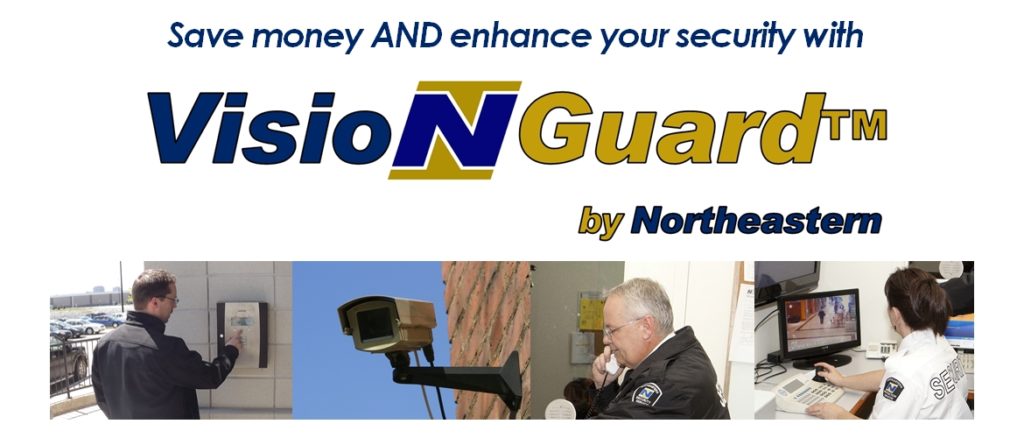
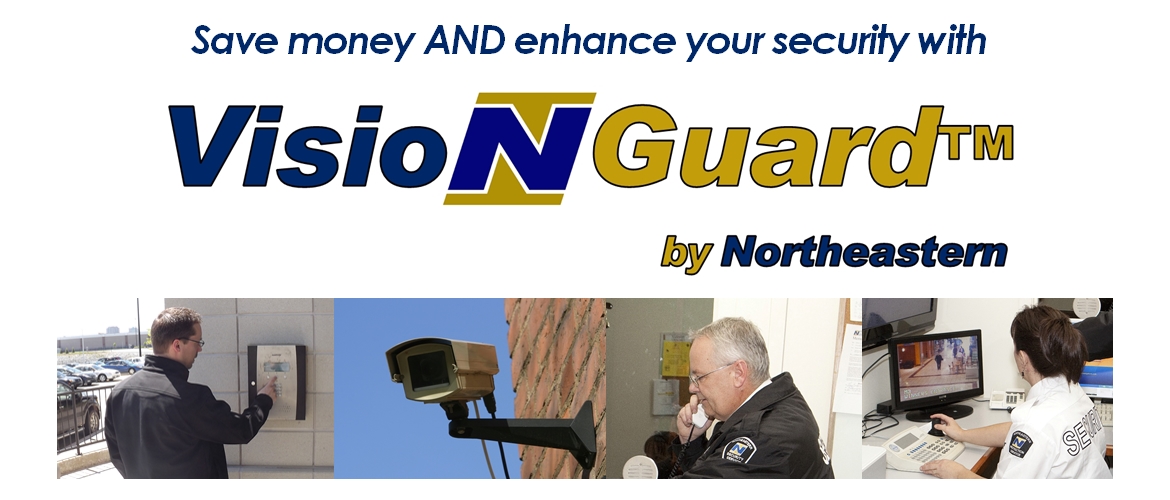
Northeastern will install state-of-the-art video capturing equipment, a two-way intercom system, and access control hardware at your facility1. Our remote VisionGuard™ will have the ability to access video at the designated sites, verify identification, unlock doors, and provide two-way audio to communicate with the facility manager, clients, employees, guests and coordinate emergency responders as needed. When controlling access to your property, our remote monitoring staff will follow your unique security plan as part of their script, so you are always in control.
Where VisionGuard Works Best
Remote monitoring is not a universal substitute for a guard, and we’d rather set the boundary honestly than oversell it. It performs best where a defined area needs watching after hours and the goal is to interrupt intrusion rather than serve people.
Construction sites. Copper, tools, fuel and equipment, on a site whose layout changes weekly and where a guard shack is impractical. Cameras redeploy as the site evolves, and an operator can challenge someone at 2 a.m. before anything reaches a truck.
Equipment yards, laydown areas and vehicle storage. Large open areas, expensive contents, minimal legitimate night activity — close to an ideal case.
Warehouses and distribution after hours. Monitored loading docks and perimeters overnight, with your staff and access control handling the working day.
Car and equipment dealerships. High-value inventory sitting outdoors, unattended, with predictable overnight vulnerability.
Vacant or transitional properties. Buildings between tenants, closed facilities and properties awaiting redevelopment, where a full guard is difficult to justify but total absence invites occupation and damage.
Multi-site portfolios. Where a single operator covers several of your properties, the economics improve sharply compared with staffing each one.
Where a guard is still the better answer: sites needing reception, access management and human interaction during business hours; environments where someone must physically intervene, escort staff or manage crowds; and complex interiors where camera coverage would be prohibitively extensive. Many clients run a hybrid — officers during active hours, VisionGuard overnight — which is usually the best value of all.
What an Operator Actually Does
The difference between VisionGuard and a recorded camera system is that someone is watching, and can act. Detection is driven by analytics tuned to your site, so operators respond to relevant events rather than staring at idle screens. When an event triggers, the operator assesses live: a person on the perimeter at 2 a.m. is not the same as a raccoon or a headlight sweep, and human judgment is what separates them.
Then the intervention, which is the part clients underestimate. The operator can speak through on-site audio — and being addressed directly, by name of location, from an unseen voice ends a large share of incidents immediately. Most intruders are opportunists, and the calculation changes the moment they learn they’re being watched in real time.
If it doesn’t end there, the operator dispatches police, and can dispatch Northeastern mobile response where available. Because the operator watched it happen, police receive a verified in-progress report with a description, rather than an unverified alarm — which affects both priority and outcome. Every event is logged with the video attached, and you receive the record. [CONFIRM: audio challenge capability, dispatch protocol, reporting format]
The Cost Comparison, Honestly

The reason clients look at remote monitoring is cost, so here’s the real structure of it.
An on-site guard is a continuous labour cost: one officer, one site, for every hour covered — and overnight coverage means paying for many hours in which nothing happens. Remote monitoring shifts most of that cost from labour to equipment. There’s an up-front investment in cameras, analytics, audio and connectivity, then a monitoring fee that is a fraction of guard hours, because one operator covers multiple sites simultaneously.
For a site needing overnight-only coverage, the saving is typically substantial. The comparison is closest — and sometimes favours the guard — where coverage hours are short, the site is small, or human presence during business hours is genuinely required.
We’ll do the arithmetic with you honestly, including the cases where it doesn’t favour us. Northeastern provides both services; we have no incentive to push you toward the wrong one. [CONFIRM: whether to publish a typical percentage saving or price range]
What a Deployment Involves
Remote monitoring is not a matter of pointing existing cameras at an operator, and understanding the deployment explains both the cost and the effectiveness.
Camera positions are chosen for detection, not documentation. A camera intended to record evidence can be mounted for coverage; a camera intended to trigger reliable analytics must see approach routes with a clean field of view, appropriate distance and consistent lighting. Positions are chosen so that someone entering the site is detected while still at the perimeter, which is what makes intervention possible.
Lighting and infrared are part of the design. Analytics degrade in poor light, and most incidents occur in darkness. Deployments usually include IR illumination or supplementary lighting, which has the useful side effect of deterring people before anything triggers.
Audio has to reach. Voice intervention only works if it is audible and intelligible where the person is standing, so speaker placement and coverage are designed alongside the cameras rather than added afterward.
Connectivity is engineered, not assumed. Sites need reliable upload bandwidth. Where wired connectivity is unavailable — construction sites, yards, vacant properties — cellular connectivity is standard, and bandwidth is managed so that live assessment is possible without saturating the link.
Analytics are tuned to the site, then retuned. Every site generates its own false triggers: a flag, headlights sweeping a fence, wildlife, blowing snow. The first weeks involve refining detection zones and rules so that alerts remain meaningful. A system that cries wolf gets ignored, and that is the failure mode we work hardest to avoid. [CONFIRM: typical tuning period]
Rules of engagement are agreed with you. What triggers an audio challenge, what triggers police, what triggers mobile response, who is called and in what order, and which areas or times are exempt because your own staff are legitimately on site.
What are the costs involved? Is it worth the investment?
There is a one-time installation fee for the hardware, and a recurring monthly fee for the VisionGuard™ monitoring service. These fees add up to MUCH LESS than a traditional guard service. We can also finance the hardware installation for a low monthly fee; this will free up your capital expenditure and make it easier for many managers to obtain spending approvals. Another bonus is that once the system is paid for, you have a state-of-the-art asset on your balance sheet. Did we also mention that the hardware we install is non-proprietary? That means you are not “stuck” with one particular service provider; and parts are easily sourced and readily available in an emergency. Financially there is really NO downside!
How will VisionGuard™ save me money?
Not only will VisionGuard™ be an effective security tool for many client facilities using (or considering using) traditional guard services, it also offers a significant ROI that will pay dividends for years to come! Based on an eight hour per day guard replacement (10:00pm to 6:00am as an example) at an initial one-time investment cost of approximately $25,000.00 (prices may vary) your savings over a three-year period would be $117,800.002 per site! This pricing is an illustration and your actual savings could be higher (this number is based on a typical billing guard rate, monitoring fees, and estimated initial equipment investment of $25,000.00).
What other benefits does VisionGuard™ provide?
For facilities that do not currently have a CCTV camera system, you will receive many additional benefits. Once the VisionGuard™ technology is installed, your on-site DVR will have recorded video which can be reviewed at a later date. Our monitoring centre employees can also do the reviewing for you! Recorded video has been proven to assist in situations such as slip-and-fall claims, for example, where video can be reviewed to verify the actual series of events. There are multiple situations unrelated to access control for which recorded video can be very useful to the client.
As well, the system may/can include access control door hardware. For clients that do not currently use this technology, this will allow you to replace traditional “keys” with proximity cards to gain access to the building. If the user ever loses a card, it can be easily deactivated and a new card issued at a fraction of the cost of traditional keys or re-keying a lock. If your facility currently uses access control that is compatible with the VisionGuard™ system, not only will it save you money on the installation cost, but Northeastern provides some of the MOST competitive prices for access control supplies on the market!
How can I determine if VisionGuard™ is the right fit for my company?
We’re glad you asked! Contact us today for a FREE no-obligation consultation! We will meet personally with you and/or your team to discuss the advantages that VisionGuard™ will bring to the table, and how we can tailor the solution to your specific needs! We can also provide references and examples of working solutions involving VisionGuard™ technology!
Frequently Asked Questions
Is someone watching my cameras all night?
Operators monitor sites with analytics-driven alerting, so attention goes to events rather than idle screens. When an event triggers, an operator assesses it live and acts.
Can it work with my existing cameras?
Sometimes. Remote monitoring requires cameras with adequate coverage, night performance and connectivity — existing systems can occasionally be adapted, and often need supplementing. We assess before recommending. [CONFIRM]
What happens if the internet goes down?
Connectivity is a design consideration, including cellular backup for sites where it’s critical. We’ll be direct about what a given site’s connection can support. [CONFIRM]
Does it replace my alarm system?
It complements rather than replaces it. Intrusion alarms detect entry; remote monitoring adds live eyes and voice intervention, usually before entry occurs.
Can we try it on one site first?
Yes — most multi-site clients start with the property causing the most trouble, then expand once they’ve seen it work.
CONTACT US TODAY FOR A FREE, NO-OBLIGATION QUOTE!
1 – Customer must provide a high-speed internet connection. The hardware that we install may vary depending on circumstances at your facility. The exact hardware requirements and associated costs will be determined after a site visit. Every effort will be made to use existing security hardware devices if they are compatible with the VisionGuard™ technology.
2 – The quoted cost-savings is based on several variables including cost of existing guard services, hours of coverage, and cost of installation. Your actual savings may vary.
© Northeastern Protection Service Incorporated – All Rights Reserved
One accountable provider, from planning to response.
Free, no-obligation consultations across Nova Scotia, New Brunswick and PEI.
Request a Free Consultation