
Uniformed Security
Uniformed Security personnel are a large segment of our company, and our greatest asset is our diverse team of Security Officers and Team Leaders. We provide long-term contract security to a number…
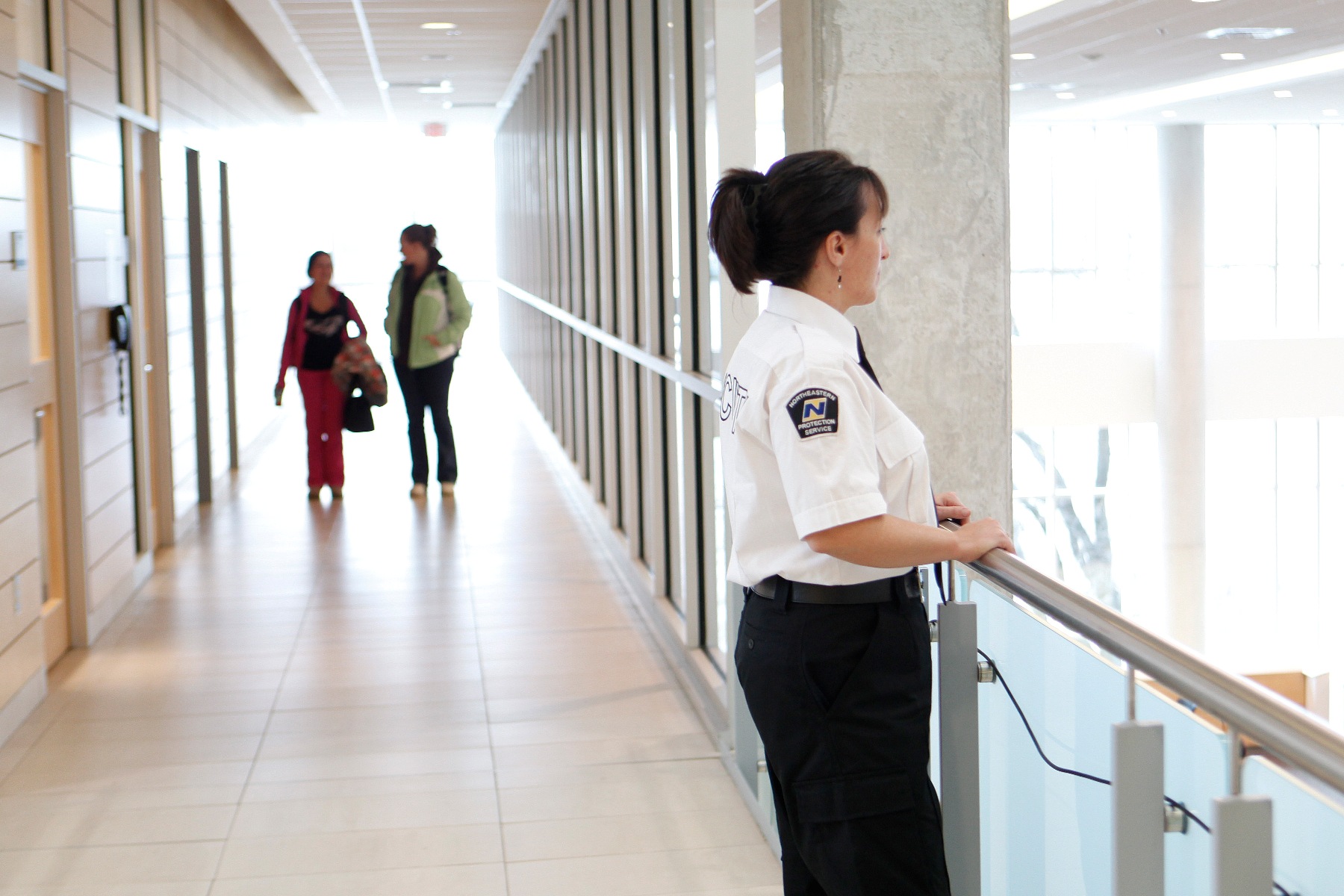
Uniformed Security personnel are a large segment of our company, and our greatest asset is our diverse team of Security Officers and Team Leaders. We provide long-term contract security to a number of local, national, and international clients. Our expertise in hiring, training, managing and providing quality individuals on a 24-hour basis for more than 30 years has given us the resource-base to handle any security detail, whether it be for a short-term project or an ongoing contract basis.
Local, national and international organizations have relied on Northeastern for professional security services for more than 40 years. Some of that work is public: uniformed security at the Greater Moncton International Airport under a multi-year contract with the Airport Authority, and a multi-year contract providing uniformed security services at Saint Mary’s University in Halifax. Much of it isn’t public, because clients prefer it that way. If you’d like references from an organization comparable to yours, we’ll provide them during the proposal process. [CONFIRM: reference process wording]
What Our Officers Actually Do
“Security guard” covers a wide range of work, and the difference between a good contract and a bad one usually comes down to how precisely the role was defined before anyone was posted. Typical Northeastern assignments include:
Access and reception control. Verifying identity, issuing visitor badges, managing contractor sign-in, and being the calm first point of contact for everyone entering a building. On many sites this is the highest-value function an officer performs, and it’s the one most often underestimated.
Patrols, interior and exterior. Scheduled and randomized patrols of floors, stairwells, mechanical rooms, perimeters and parking areas — checking doors that should be locked, lights that should be on, and hazards that shouldn’t be there.
Alarm and incident response. First response to alarms, medical incidents, and disturbances, working to written post orders agreed with you and escalating to police, fire or EHS as required.
Monitoring and control room duties. Watching camera systems, managing access control software, and coordinating response — often alongside our video surveillance and access control systems.
Documentation. Shift reports, incident reports and log entries that hold up when an insurer, a lawyer or a regulator asks what happened. Officers who write well are worth more than officers who don’t, and we hire accordingly.
De-escalation and public interaction. On campuses, in retail environments and in multi-tenant buildings, most of what an officer handles is a person having a bad day. Judgment matters more than physical presence.
Licensing, Screening and Training
Every Northeastern security officer is licensed under Nova Scotia’s Private Investigators and Private Guards Act (and the equivalent legislation in New Brunswick and PEI where they work), which sets the baseline for criminal record checks and qualification. We treat that as the floor rather than the standard.
Our screening covers criminal record checks, employment verification and reference checks before an officer is assigned, with additional clearances for sites that require them — aviation contracts in particular carry Transport Canada requirements that go well beyond provincial licensing. [CONFIRM: specific screening steps and clearance types you want published]
Training runs on two tracks. Core training covers legal authorities and their limits, use-of-force policy, emergency and fire procedures, first aid certification, report writing and customer service. Site-specific training covers your post orders, your building, your escalation contacts and your particular risks — because an officer who knows the general theory but not your loading dock isn’t much use in the first month. [CONFIRM: first aid certification standard and core training curriculum]
Supervision Is What You're Really Buying
Any company can put a person in a uniform. The difference between contracts that work and contracts that quietly deteriorate is supervision, and it’s worth asking every bidder exactly how theirs works.
Ours is built on field supervision — supervisors who physically attend sites, including on nights and weekends, rather than managing by phone from an office. Our mobile units perform guard checks as part of their patrol routes, so an officer on a quiet overnight post knows someone may arrive at any hour. That single fact does more for consistency than any policy document.
Beyond that: a scheduled account review with a named manager rather than a call centre; documented shift reports you actually receive; and a straightforward escalation path when something isn’t right. If an officer isn’t the right fit for your site, we replace them — no argument, no defensiveness. [CONFIRM: account review cadence and supervisor visit frequency]
Starting a New Contract Without the Usual Disruption
Changing security providers is the part clients dread, usually because they’ve done it badly before. A transition handled properly is largely invisible to your staff and tenants.
Post orders come first. Post orders are the written instructions that define what officers do at your site: patrol routes and timing, access rules, who may be admitted and on whose authority, emergency and fire procedures, escalation contacts, and reporting requirements. Most problems attributed to “bad guards” trace back to post orders that were vague, outdated, or never written down. We draft them with you before the first shift and review them as the site changes.
Staffing overlaps the changeover. Where we’re replacing an incumbent, our officers work alongside the outgoing team during handover wherever the client permits it, so site knowledge transfers rather than evaporating at midnight on the last day of the contract.
Existing officers are often worth keeping. When a contract changes hands, the officers frequently stay with the site rather than the company — they know the building and the people. Where an officer is a good fit and wants to remain, we’re glad to hire them. It’s better for the site than starting from zero, and it’s a fairer outcome for people who’ve done nothing wrong. [CONFIRM: comfort level publishing this]
The first thirty days get extra attention. Increased supervisory visits, early check-ins with your contact, and rapid adjustment as the reality of the site emerges. Every site has quirks that never appear in a tender document.
If You're Writing an RFP or Comparing Bids
Guard contracts are usually awarded on hourly rate, which is why so many disappoint. A rate is easy to compare and tells you almost nothing about what you’ll receive. Questions that reveal more:
What is the officer wage as a proportion of the billed rate? Chronically low wages produce turnover, and turnover means a stranger at your site every few weeks. How is supervision delivered — by phone, or by supervisors physically attending, including overnight? What is your annual turnover rate on comparable contracts? Who covers a sick call at 5 a.m., and how quickly? What training is provided beyond the licensing minimum, and who pays for it? Will you provide references from sites like ours?
We’d rather be judged on those answers than on being cheapest, and any provider confident in their operation should feel the same. If a bid is significantly below the others, the difference is being taken from somewhere — usually wages, supervision or training, all of which end up at your site eventually.
Contract, Event and Emergency Coverage
Long-term contract security is the core of the business — ongoing coverage for buildings, campuses, industrial sites and institutions, with dedicated officers who learn your site and your people.
Event security covers conferences, sporting events, concerts and corporate functions, scaled to crowd size and risk profile. [CONFIRM: event capacity and lead time]
Labour disruption coverage is specialized work requiring officers trained in documentation, neutrality and de-escalation under sustained tension. If you’re preparing for a possible disruption, plan early — the quality of coverage available at two days’ notice is not the quality available at two months’. [CONFIRM: labour disruption lead time]
Short-notice and temporary coverage for a vacancy, a construction phase, a seasonal peak or a specific incident.
We have overseen the transition of hundreds of security contracts in the past; our track record speaks for itself. We can provide a worry-free transition that is nearly transparent to your clients and daily operations.
The Northeastern management team has a long history of protecting some world-renowned clients and events. This history has helped us to develop a world-class knowledge of security issues, strategies, and practices that benefit all of our clients.
Some of the larger events that our management team has participated in are:
- Movie Productions filmed in our region
- Premier’s Conference
- G-8 Finance Minister’s Conference
- Sommet de la Francophonie
- G-7 World Summit
- Corporate Labour Disputes affecting national or international companies
Frequently Asked Questions
Are your security officers licensed?
Yes. Every officer is licensed under Nova Scotia’s Private Investigators and Private Guards Act, or the equivalent legislation in the province where they work, with criminal record checks completed before assignment.
Are your guards employees or subcontractors?
Northeastern officers are our employees, supervised by our management. [CONFIRM: confirm employment model before publishing]
Can we meet the officers before they start?
Yes, and we encourage it for long-term contracts. Site familiarity and a working relationship with your staff are what make a posting effective.
What happens if an officer calls in sick?
Coverage is our responsibility, not yours. Scheduling and relief staffing exist precisely so your post is filled without you making phone calls at 6 a.m.
Do you provide armed security?
Our services are unarmed uniformed security. Situations requiring an armed response are police matters, and we coordinate with them accordingly. [CONFIRM]
Can guards be combined with cameras and monitoring to reduce cost?
Often, yes — that’s exactly what VisionGuard™ remote video monitoring is for. Many sites use a hybrid: officers during high-activity hours, remote monitoring overnight, at meaningfully lower cost than 24-hour guarding.
If you are preparing for a major event, a labour disruption, or developing your company Security Plan, contact our specialists for a free consultation. We have the experience you require to properly protect your assets.

One accountable provider, from planning to response.
Free, no-obligation consultations across Nova Scotia, New Brunswick and PEI.
Request a Free Consultation